The Euro Crisis and Supranational Banking Integration
Stopping short of Common Deposit Insurance
European Union Politics
Royal Holloway, University of London
One currency, but two levels of economic authority.
The euro created a fundamental asymmetry within Economic and Monetary Union (EMU):
Member states shared a currency and a central bank, yet governments remained individually responsible for taxation, public spending and sovereign debt.
This arrangement appeared workable in stable conditions; however, the 2008 financial crisis exposed its limits. Individual member states could not devalue their currencies or independently adjust monetary policy in response to domestic shocks.
As banking losses moved onto national balance sheets, governments were expected to stabilise their financial systems without the fiscal risk-sharing mechanisms of a fully integrated monetary union.
When Banking Risk Became Sovereign Risk
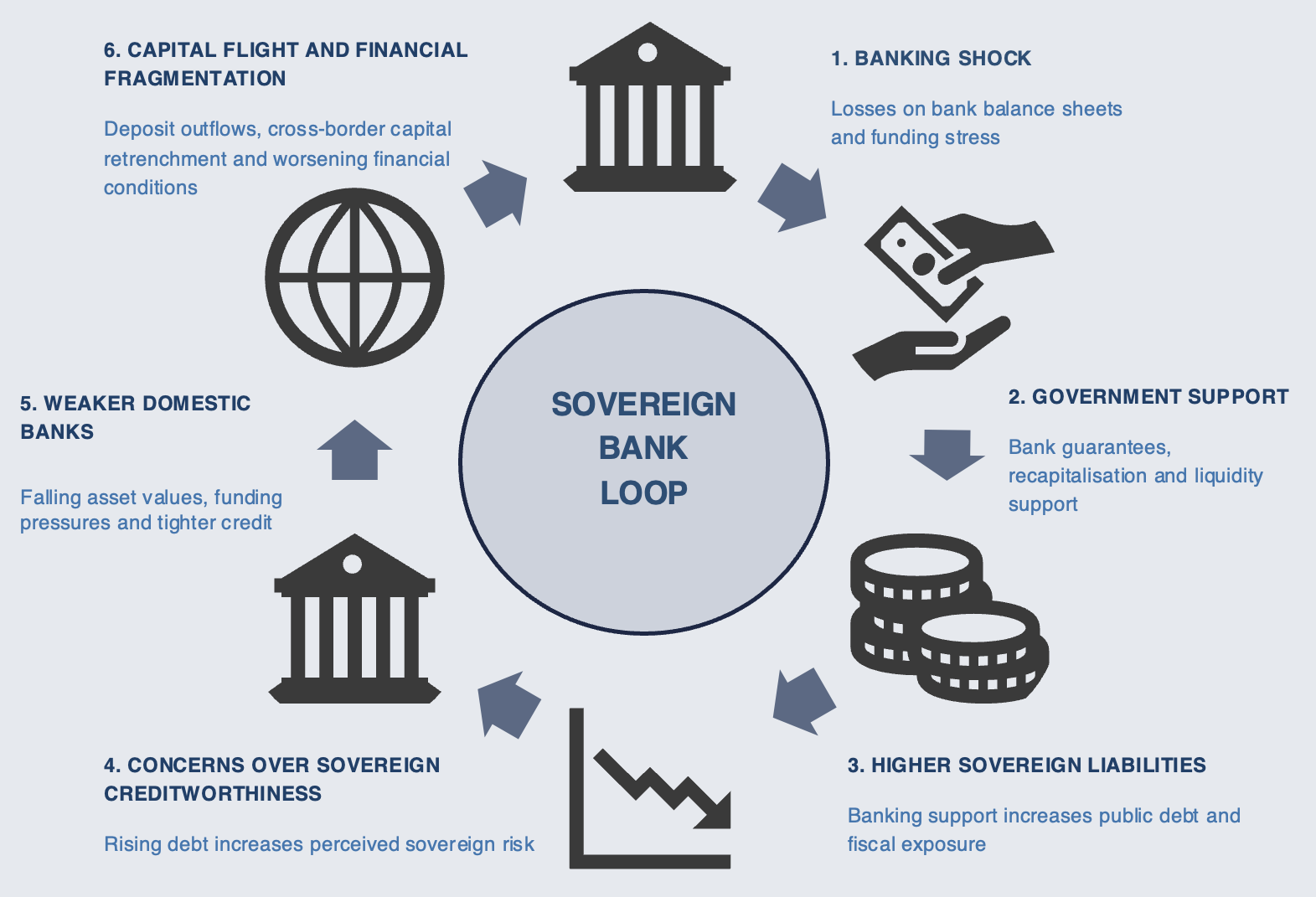
The financial crisis demonstrated how banking and sovereign risk could reinforce one another creating a self-perpetuating cycle of stress across the euro area
€1.6tn
in state aid provided to the EU banking sector, 2008-2010.
The crisis exposed a fundamental weakness in the monetary union: banks operated within an integrated European financial system, but responsibility for rescuing them remained with national governments. When banks failed, the cost of stabilising them could therefore fall on national balance sheets, linking banking instability directly to public finances.
Crisis as a Catalyst for Financial Integration
The euro crisis forced the EU to develop new institutions and crisis-management mechanisms that would previously have been politically difficult, shifting greater responsibility for financial stability towards the European level.
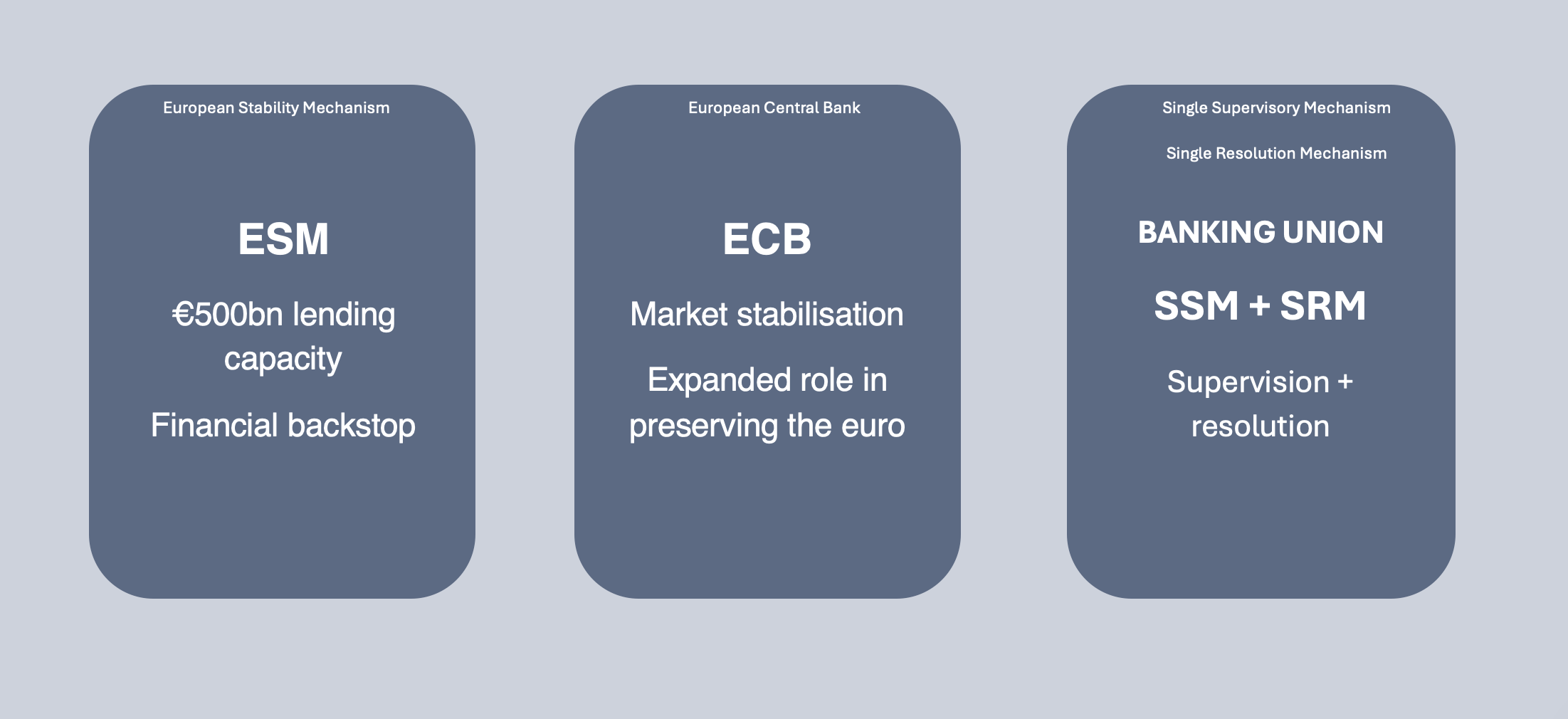
A shift towards supranational financial governance
The response was not the creation of a full fiscal or political union, but the expansion of European-level institutions needed to stabilise and preserve the monetary union.
Integration stopped short
The crisis transformed the EU’s financial architecture, but integration remained incomplete.
Banking Union transferred significant supervisory and resolution authority from member states to the European level. Yet one important part of the financial safety net remained national: deposit insurance.
This created a new asymmetry within Banking Union; European-level banking supervision alongside nationally funded depositor protection
The missing third pillar: EDIS
Deposit insurance is designed to maintain confidence by assuring depositors that their money is protected if a bank fails.
Within Banking Union, however, this protection remains tied to national Deposit Guarantee Schemes. During periods of financial stress, doubts about a sovereign’s capacity to support its banking system can weaken confidence in that guarantee, encouraging deposit outflows and reinforcing the link between banks and sovereigns.
A European Deposit Insurance Scheme (EDIS) would address this remaining weakness by providing common deposit protection at the European level, reducing the dependence of depositor confidence on the fiscal strength of individual member states.
My policy recommendation: a phased route to EDIS
In my policy brief, I recommended a phased transition towards EDIS, balancing the economic case for common deposit protection against political concerns over moral hazard and cross-border risk sharing.
1: RISK REDUCTION
Strengthen bank balance sheets and reduce concentrated sovereign exposures.
2: REINSURANCE
National schemes remain the first line of defence, with a European fund providing a backstop.
3: CO-INSURANCE
European funding contributes from the outset, with its share increasing progressively.
4: FULL EDIS
Common deposit protection operates alongside supranational banking supervision and resolution.